
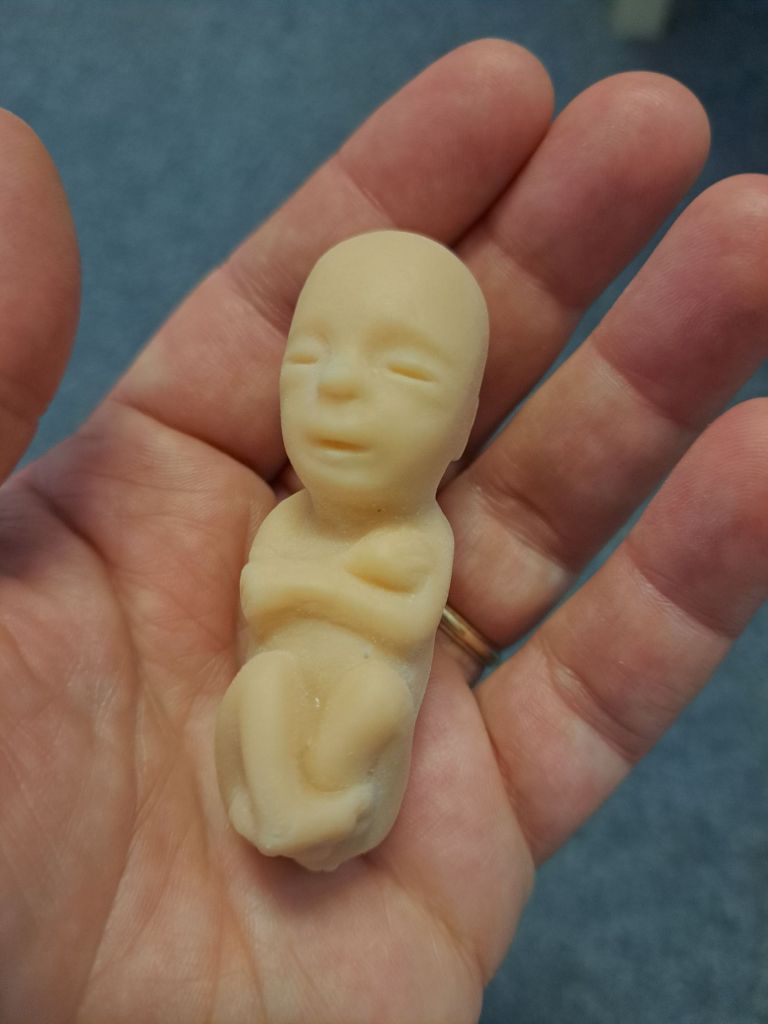
I cradled the little rubbery model of a 12 week old fetus in my hand.
“You were only this big when your mother was three months pregnant,” I said to the little girl I was talking to.
Her eyes grew wide. “I was so little!” she said.
We talked about how God made her, planned the days of her life, and provided for her eternal life too by sending Jesus to die for her sins.
She had a lot of questions. Did brother who died as a baby go to heaven? And where is Jesus now?
But perhaps her most pressing question was, “What about my dad? He only does big sins.” She explained that he lives in prison, that she isn’t allowed to see or talk to him, and that he had sent her a bead bracelet that spells “I love you.”
We talked about big sins and little sins. I asked her which ones she calls big and which ones she thinks of as little. Everyone has a different definition, you know.
If you ask your Aunt Letty, or just any passerby on the street, the big sins are usually the ones committed by other people, and the little ones are the ones we commit ourselves.
The Catholic Catechism distinguishes between “mortal sin” (the big ones) and “venial sin” (the little ones) by saying, “Mortal sin is sin whose object is grave matter and which is also committed with full knowledge and deliberate consent… It causes exclusion from Christ’s kingdom and the eternal death of hell.”
Several women in my church have asked the desperate question: “If I’ve had an abortion, am I still able to accept the forgiveness that Jesus offers or am I excluded?”
They see that same small rubber baby model, and they remember the decision they made that ended a life and the people who have told them that it ended their chance to have eternal life. They think their sin is too big for Jesus to forgive.
Perhaps that young father, sitting in jail, holding his big sins on his shoulders as he is unable to talk to his little girl, thinks he is beyond forgiveness too.
But that isn’t what Jesus taught.
He clearly taught that the wages we earn for both the big sins and the little sins is eternity in hell, but He also taught that He came to save us from both!
“Truly, truly, I say to you, whoever hears My word and believes Him who sent me has eternal life. He does not come into judgment, but has passed from death to life,” Jesus said.
Jesus doesn’t mention shades and severities of sin. All of it is severe enough to lead to judgment. However, His forgiveness is deep enough to encompass the sins of any person who repents and comes to Him- big or little.
Have you thought that your sins are too big for Jesus to forgive? Then you’re underestimating the greatness of His mercy and forgiveness, and most of all, His love.
 Sarah Dixon Young