

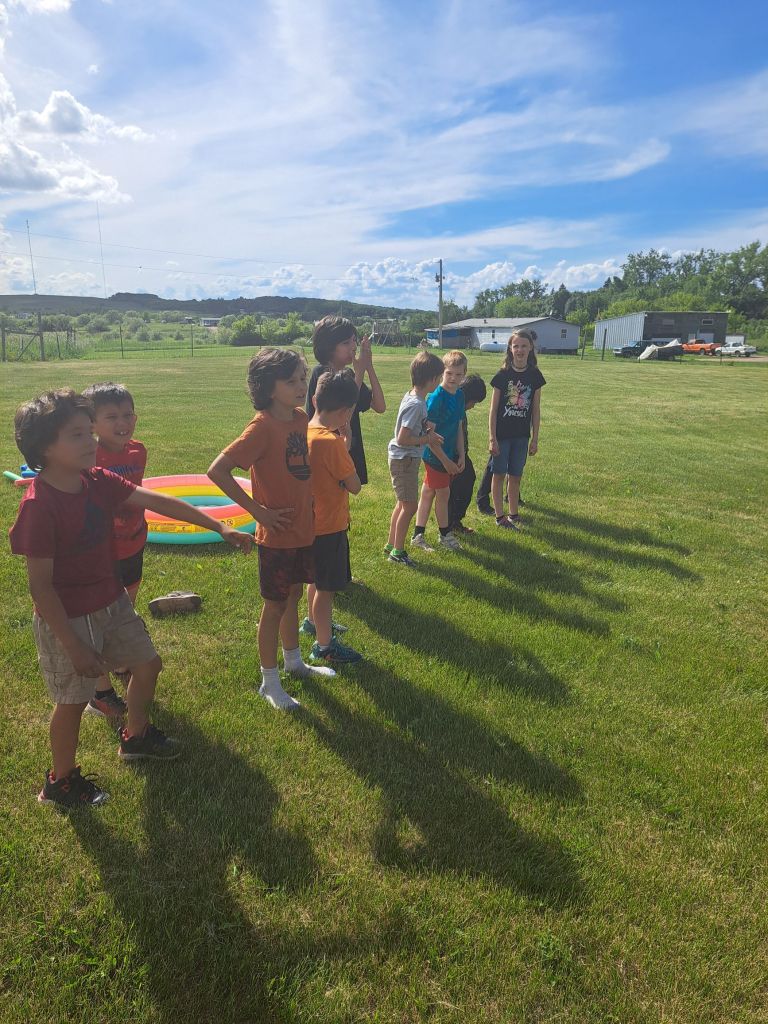
Vacation Bible School is not for the faint of heart, and I am very thankful for the army of people who helped do two in my community last week.
Needless to say, I spent a lot of time supervising the playground.
It led me to contemplate the deep differences between poetic justice and karma, even while I held someone’s popsicle and smooshed a woodtick’s head off.
The Hindu American Foundation defines Karma as “an action or deed” that results in a “reaction or outcome.” It is the universal principle of cause and effect, where an individual’s actions determine future experiences.
Allow me to give you a playground example.
Mitchell, carrying a small tractor, and seeing an available space in the sand to dig, ran directly in front of Donnell, who was swinging. Mitchell is three. Donnell is nine.
Their actions had reactions. No children were seriously harmed, but let’s just say, there were some tears, and Mitchell learned to watch out for the swing.
Karma has nothing to do with virtue or vice. Neither swinging nor digging were morally reprehensible in this scenario, but the decision still led to a bad outcome. Those bumper stickers you see about Karma being a…*an ugly word you might call a vindictive woman* are expressing the same sense of injustice little Mitchell felt. Something bad happened even though he was not being bad!
Then, there is poetic justice.
Let’s return to the playground. Names have been changed to protect the guilty.
Rachel has sticky fingers. I watched her make her rounds through everyone else’s take home bags, rifling through their crafts and bags of chips. Several items were snuck into her own bag, alongside the plate of food she had covered to take home. She set her bag beside the playground and went to play.
While we were both occupied with something else, the neighborhood dog came and rifled through Rachel’s bag, eating several of the choice goodies she had stolen in addition to the entire contents of her plate.
When it was time to go, she brought the bag to me, paper plate licked clean, and I emptied it of a candle and a book that belonged to the church before sending her on her way.
The vice of stealing was justly rewarded with the punishment of being stolen from.
Poetic justice hinges on vice and virtue, punishment and reward. The Bible is full of it. Jacob was a deceiver who was deceived. Proud Herod was eaten by worms. Haman was hung on the gallows he made for Mordecai.
When the poet, or the child, or the Sunday school teacher encounters poetic justice, we are looking at a physical representation of what the Lord will do on judgment day.
Every vice will be justly punished.
Every virtue will be justly rewarded.
There will not be a drop of Karma anywhere to be seen.
And just like at Bible school, everyone will realize that our virtue can never outweigh our vice. Some other provision must be made for the times we have chosen to do evil.
One day, Jesus will cancel Karma and bring poetic justice to its ultimate fulfilment as every knee will bow and every tongue confess that He is Lord, to the glory of God the Father. Divine Justice will have been satisfied by the Cross, and every playground will be devoid of both tears and thieves.

